Recovery Is Training Too: Why More Work Does Not Always Mean More Progress
Training hard matters, but progress depends on what happens between workouts, too. Learn how sleep, fatigue, training volume, rest days, and recovery affect strength, muscle growth, and long-term performance.

There is a particular kind of confidence that shows up after a really good week in the gym. Everything feels strong, the workouts are clicking, the pump is good, and maybe you added five pounds to a lift or squeezed out a couple of extra reps. Naturally, your brain looks at all of this success and comes to the most dangerous conclusion possible: “I should probably do more.”
This is roughly how a great training week can turn into three weeks of wondering why your elbows hurt, your shoulders feel questionable, and the weight you handled easily last Tuesday suddenly feels like somebody filled the plates with concrete.
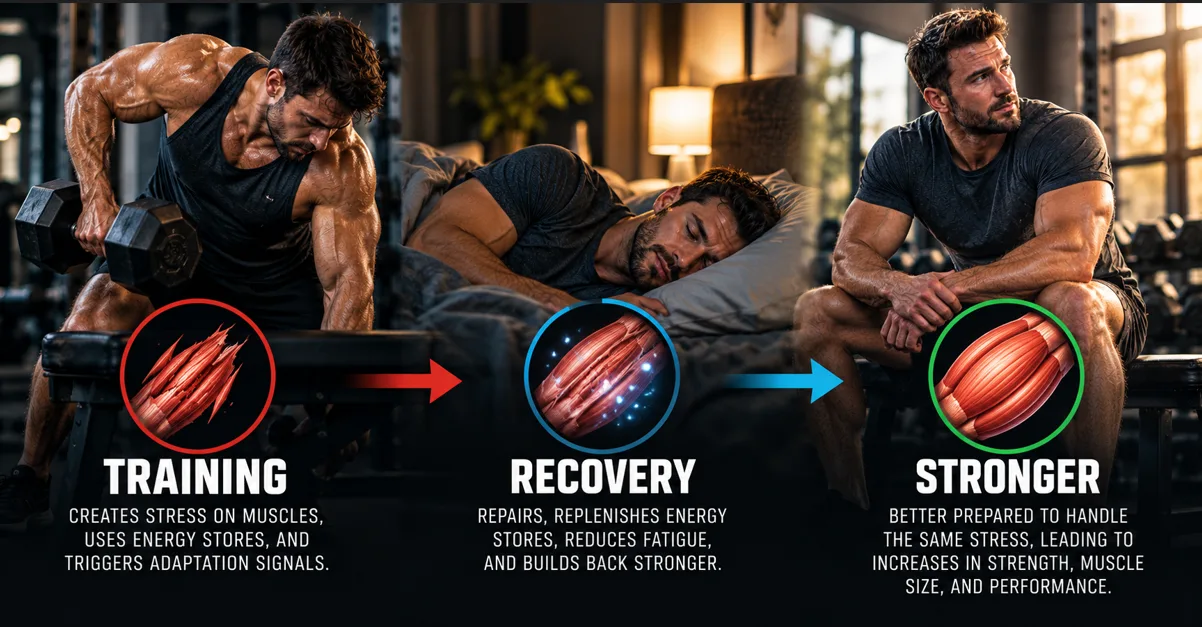
Working hard matters. Consistency matters. Effort absolutely matters. But your body does not give extra credit just because you suffered impressively. Training creates a stimulus, and recovery allows your body to respond to it. That relationship between stress and recovery is where progress actually happens.
A good training program has to accomplish two things at the same time. It needs to provide enough stress to encourage your body to adapt, while still allowing enough recovery for those adaptations to take place. When you continually increase the first part while ignoring the second, you eventually stop creating better workouts. You just become extremely efficient at getting tired, which is a skill, technically, but probably not the one you were training for.
Training Starts the Process
Most people naturally associate progress with what happens during the workout. You lift weights, so that must be when you become stronger. You train your chest, so that must be when your chest grows. It makes sense, but physiologically, the workout is really the beginning of the process.
Resistance training places stress on muscles and the nervous system, uses stored energy, and creates signals that encourage your body to adapt to the work you just performed. Repeated over time, those adaptations can lead to increases in strength, muscle size, power, and physical performance. The American College of Sports Medicine’s updated 2026 resistance training guidance reviewed evidence from more than 30,000 participants and emphasized that resistance training works across a wide range of methods and program designs. The major improvements come from consistently training and matching the program to the goal, rather than chasing a single supposedly perfect routine that some shirtless guy on Instagram claims changed his life in 14 days.
Once the workout ends, your body has work to do. Energy stores need to be replenished, damaged structures need to be repaired, fatigue has to decline, and the nervous system has to recover from the demands placed on it. Given adequate recovery and appropriate nutrition, the body becomes better prepared to handle similar stress in the future. That is adaptation, and adaptation is what you are really trying to create every time you walk into the gym.
This is also why soreness is such a terrible scoreboard. A productive training session does not have to leave you walking sideways down the stairs for three days. On the other hand, extreme soreness is not proof that you triggered extraordinary muscle growth. Sometimes it simply proves you decided to do Bulgarian split squats for the first time since the Obama administration.

There Is a Difference Between Training Fatigue and Living in Fatigue
Fatigue is a completely normal part of training. If you push yourself, you should expect to feel tired sometimes. Muscles may feel heavy after a demanding workout, your performance may drop toward the end of a session, and a hard leg day can make sitting down significantly more dramatic than usual. Suddenly, every toilet is six inches too low, and every staircase feels personally disrespectful.
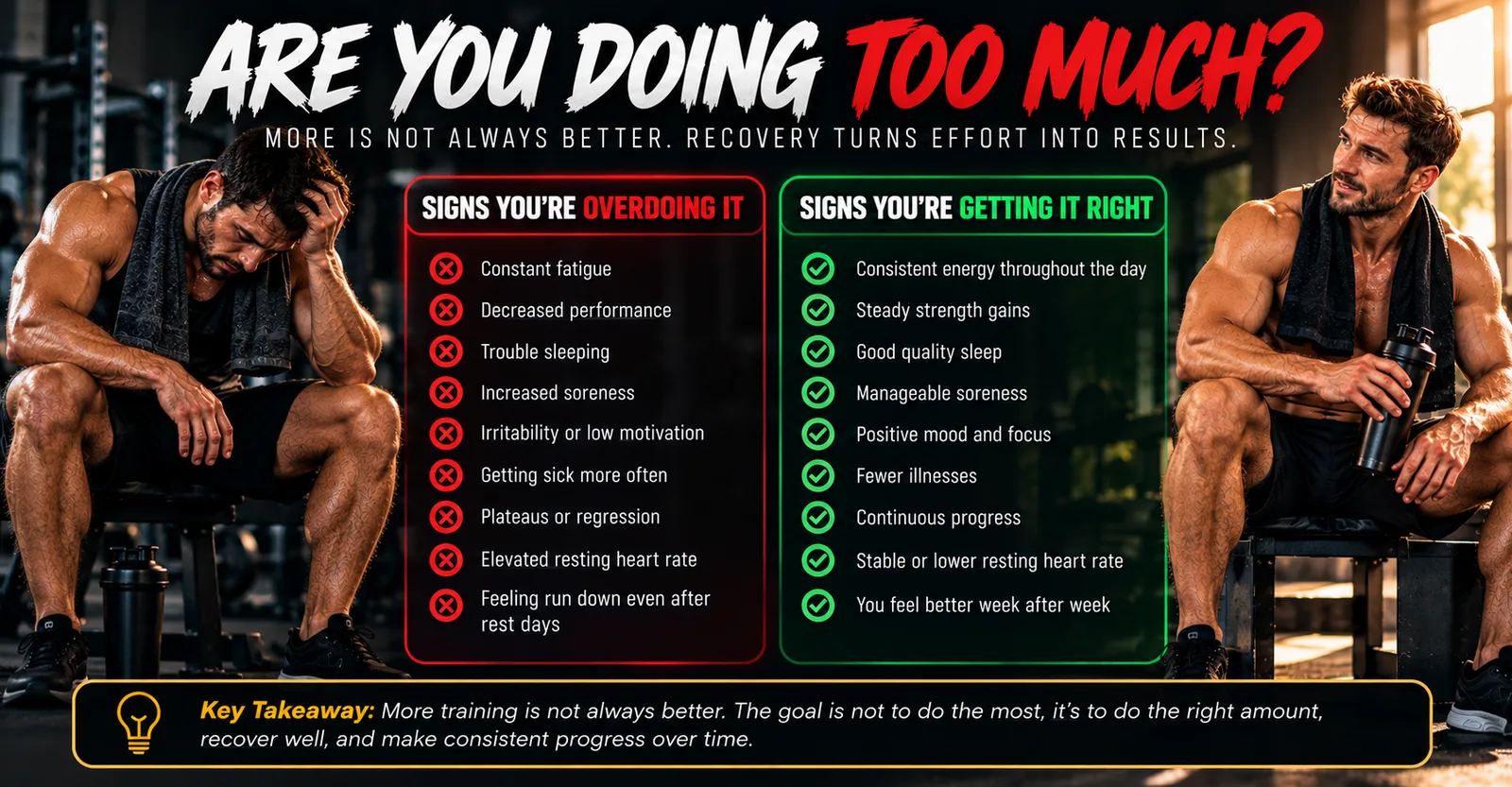
The problem develops when fatigue continues accumulating faster than you can recover from it. That can happen because total training volume becomes too high, too many workouts are performed at a very high effort level, sleep starts slipping, food intake becomes inadequate, life stress climbs, or several of those things happen at once. Your body does not keep separate spreadsheets for work stress, family stress, sleep deprivation, dieting, and training. It gets the entire bill, and unfortunately, there is no rewards program.
Highly motivated people can sometimes make this worse because the usual response to stalled progress is to add something. Bench press not improving? Add another chest day. Arms not growing fast enough? Throw in another six sets of curls. Fat loss slowed down? Apparently, we now need morning cardio and evening cardio because happiness was becoming suspicious.
More training can absolutely be useful in the right situation. Weekly resistance training volume is an important variable for muscle growth, and research generally supports a dose-response relationship up to a point. But volume has to be recoverable. Increasing the amount of work only helps while that additional work remains productive. There is eventually a point where “dedicated” quietly turns into “I have not had a normal shoulder since March.”
Training frequency works the same way. A higher frequency can make it easier to distribute your weekly workload and keep individual sessions manageable, but simply showing up at the gym more often does not automatically build more muscle. When total weekly volume is held similar, research has generally found that frequency itself has a much smaller effect on hypertrophy than people sometimes assume.
The question, therefore, should not always be, “How much more can I do?” A much better question is, “How much quality work can I consistently perform and recover from?” The second question is less exciting, but unfortunately, your muscles have never been especially interested in excitement.
Sleep Is Probably the Most Boring Performance Tool You Are Ignoring
Fitness would be much easier to sell if recovery depended on something exciting. People would happily buy a $300 recovery device, stand inside a freezing chamber, drink a neon-colored supplement with a lightning bolt on the container, and strap themselves into something that looks like medical equipment from a science fiction movie.
Tell someone they might need another hour of sleep, and suddenly everybody has somewhere else to be.
Unfortunately, sleep keeps being important.
Sleep influences physical recovery, cognitive function, perceived effort, reaction time, mood, and exercise performance. A large systematic and meta-analytical review examining acute sleep loss found an overall negative effect on physical performance across several exercise categories, including strength, endurance, high-intensity exercise, and skill-based tasks.
Research in athletes also suggests that interventions aimed at improving sleep can enhance performance and recovery, although sleep requirements vary across individuals and sports.
That does not mean a single bad night destroys your progress. You are not going to wake up after five hours of sleep and discover that your biceps have resigned. Human beings are more resilient than that. The concern is chronic sleep restriction combined with demanding training.
If someone is lifting hard five or six days per week, working a stressful job, dieting aggressively, and routinely sleeping five hours per night, there is a decent chance the problem is not that their supplement stack is missing magnesium harvested during a full moon.
Before we completely rewrite the training program, let's look at the obvious items. Sometimes the advanced recovery protocol is just going to bed.

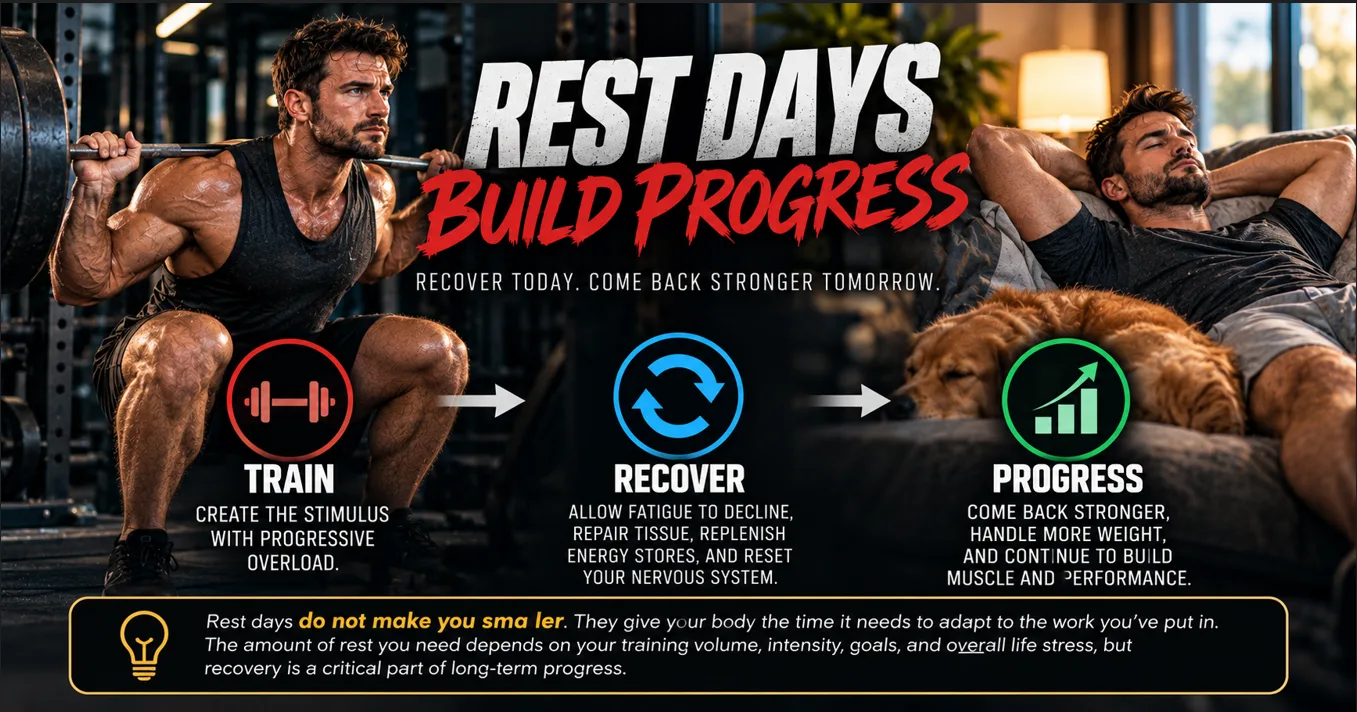
Rest Days Do Not Make You Smaller
Rest days make some dedicated gym-goers strangely uncomfortable. Once training becomes part of your identity and routine, sitting at home can feel like you are actively losing progress. You can almost picture your muscles quietly packing their bags because you failed to perform lateral raises today.
That is not how any of this works.
Rest days give accumulated fatigue a chance to decline so that you can return to training capable of producing quality work. Depending on the program and the individual, a recovery day might involve complete rest, walking, some easy mobility work, a recreational activity, or simply training a different area of the body. You are allowed to exist for 24 hours without trying to PR something.
The exact number of weekly training days is less important than matching the total workload to the individual. Research comparing different resistance training frequencies has shown that multiple approaches can produce good results, especially when total weekly volume is similar. A study comparing resistance-trained men lifting three versus six days per week, for example, found similar improvements in strength and muscle thickness when training volume was equated.
That is useful because it gives you options. Someone who enjoys being in the gym six days per week can distribute their workload across six shorter sessions. Someone with a demanding career, family obligations, or limited time may accomplish the same weekly training volume in three or four sessions.
Neither person automatically has the better program because they swipe their gym membership card more often. The scanner does not award hypertrophy points.
Recovery capacity also differs dramatically between people. A college student with relatively few responsibilities may tolerate a training schedule that would crush someone working 50 hours per week, raising kids, sleeping six hours, and dieting at the same time. Training programs exist inside real lives, and real lives matter.
You Probably Do Not Need to Take Every Set to Failure
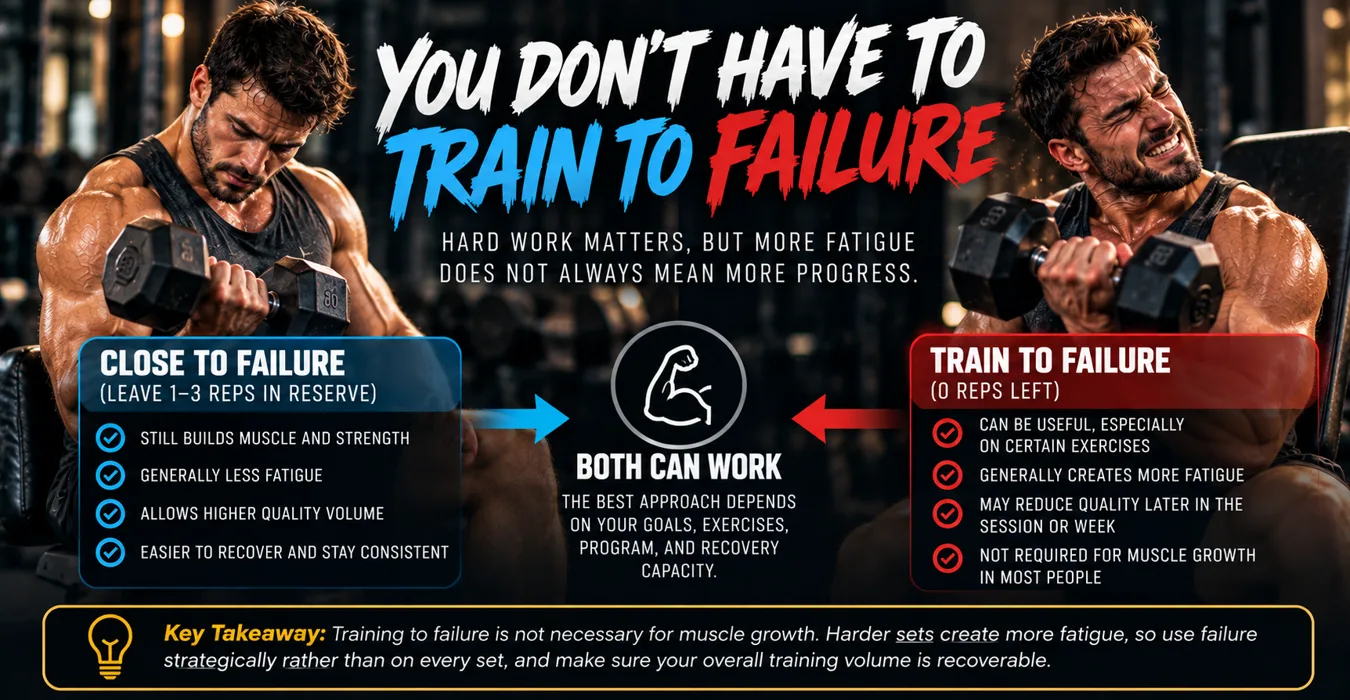
Training close to muscular failure can be useful, particularly when muscle growth is the goal. The closer a set gets to the point where another good repetition is not possible, the more demanding that set becomes.
Somewhere along the way, however, the bodybuilding world decided that a set only counts if your training partner is performing most of the final repetition while screaming, “ALL YOU!” even though it is very clearly no longer all you. At that point, it is at least 40 percent him.
Research does not support the idea that every working set must reach momentary muscular failure for muscle growth to occur. A systematic review and meta-analysis examining proximity to failure found no clear hypertrophy advantage for consistently taking sets to momentary failure compared with stopping short of failure.
The updated ACSM guidance reaches a similar practical conclusion. Training to momentary muscle failure is not necessary for the average healthy adult to improve strength or hypertrophy.
That does not make failure training useless. There are perfectly reasonable situations where taking a set to failure makes sense, particularly with certain exercises, machines, isolation movements, or carefully programmed sets. The issue is fatigue management. Harder sets generally produce greater fatigue, and repeatedly turning every exercise into a maximum-effort event can eventually reduce the amount of quality work you can perform later in the session or later in the week.
Leaving a small number of repetitions in reserve on some working sets can allow you to train hard while still controlling fatigue. Then, when you decide to push a set all the way, you are doing it because it fits the program rather than because suffering has somehow become the unit of measurement.
Recovery Is Usually Much Less Exciting Than People Want It to Be
The fitness industry has created an impressive number of ways to recover from a workout. You can buy massage guns, compression boots, electrical stimulation devices, cold plunges, infrared saunas, red-light systems, specialty supplements, mobility tools, and probably something involving vibrations that claims to “activate cellular recovery.”
Give it another year, and somebody will sell a $900 recovery blanket with Bluetooth.
Some of these things may have specific uses. None of them replaces the fundamentals.
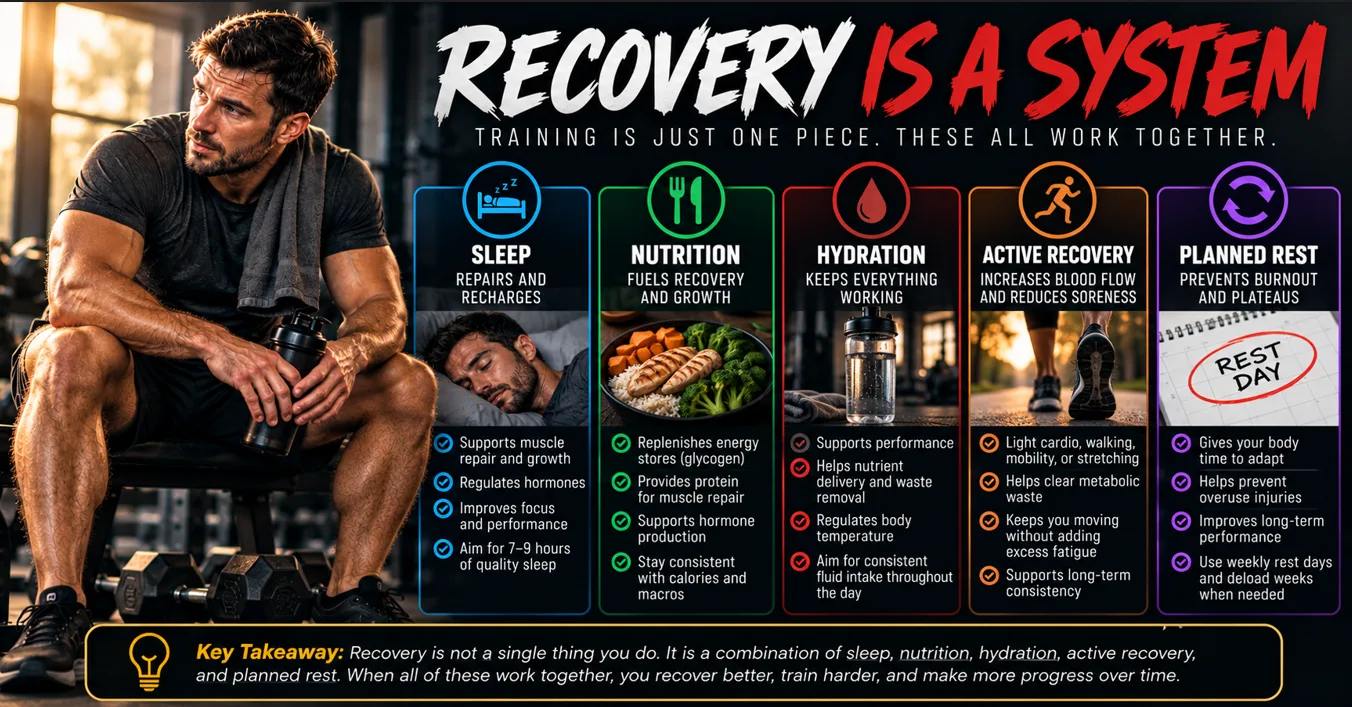
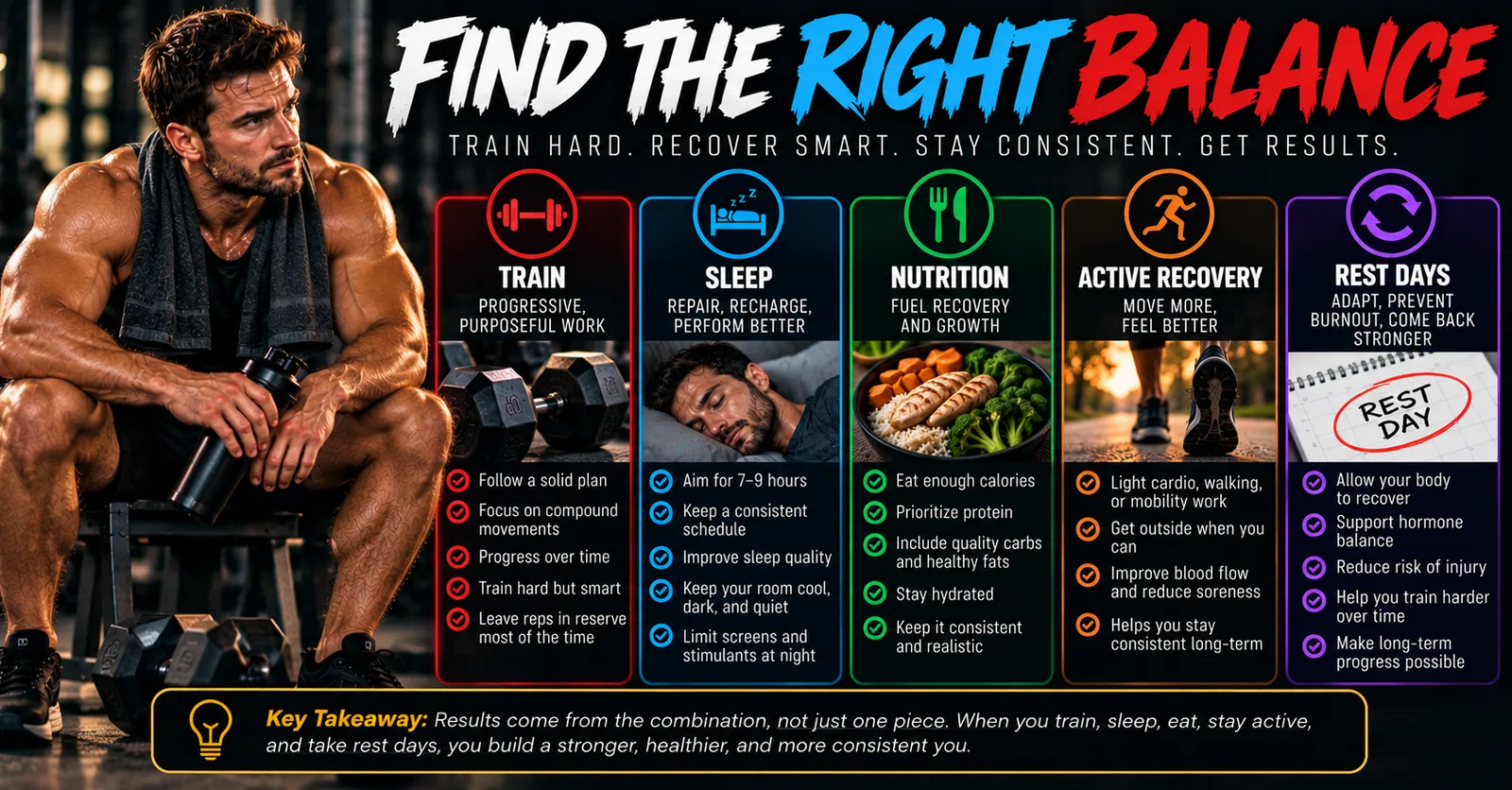
For most recreational lifters, most recovery comes from a fairly ordinary combination of adequate sleep, appropriate nutrition, sufficient protein intake, hydration, intelligently managed training volume, and enough time between demanding sessions for the muscles involved to recover. When those basics are consistently handled well, most people are already covering a very large portion of what they need.
Recovery can also include light activity. Walking, easy cycling, gentle mobility work, and other low-intensity movement can be perfectly reasonable on a recovery day. The important part is keeping it genuinely easy. If your “active recovery” session ends with you bent over your knees, sweating through your shirt, and reconsidering your life choices, you have successfully created another workout.
There is nothing wrong with enjoying recovery gadgets or routines. Use them if you like them, they make you feel better, or they help you stick to good habits. Just keep the priorities in order. A massage gun cannot out-recover five hours of sleep and twelve consecutive days of hard training, no matter how aggressively you point it at your quads.
How Do You Know When You Need More Recovery?
There is no single perfect measurement that tells you whether you are fully recovered. Recovery is better judged by patterns than by one isolated data point.
Everybody has bad workouts. Maybe you slept poorly, work was stressful, you trained at an unusual time, or the barbell simply decided to be disrespectful that day. One bad session does not mean anything is wrong. Sometimes gravity is just having a good day.
It becomes more meaningful when several things start happening together and continue for a while. You may notice that weights you normally handle comfortably feel heavier across multiple workouts. Repetition performance may decline, motivation may drop, soreness may linger longer than usual, or small aches and pains may start appearing more frequently. Sleep quality can suffer, mood can change, and your normal training pace may suddenly feel much harder to maintain.
Those signs do not automatically mean someone is “overtrained,” a term that gets thrown around far too casually. True overtraining syndrome is considerably more serious than simply needing a few easier days. Most recreational lifters who feel run-down are more likely to be dealing with accumulated fatigue or short-term under-recovery.
When performance trends downward while fatigue, soreness, poor sleep, and general stress are trending upward, adding another hard workout usually would not be my first move. If every warning light on the dashboard is on, pressing the gas harder is usually not the best strategy.
A temporary reduction in training stress can often help. That might mean reducing the number of sets, using slightly lighter loads, keeping more repetitions in reserve, taking an additional rest day, or running a deliberate deload week.
A deload is simply a temporary period of reduced training stress. Some lifters schedule them at regular intervals, while others use them when performance and recovery suggest one is needed. There is no universal law requiring everyone to deload every fourth, sixth, or eighth week. Training age, program design, volume, intensity, lifestyle, and individual recovery all matter.
Your Training Program Has to Fit Your Life
There is a strange tendency in fitness to judge programs by how intimidating they look on paper. Six training days must be more serious than four. Twenty sets must be better than twelve. A two-hour workout must be more effective than a 60-minute workout because you suffer for twice as long.
None of those things is automatically true. Misery has never been a recognized unit of exercise volume.
The 2026 ACSM position stand is actually refreshing in this regard. After reviewing 137 systematic reviews involving more than 30,000 participants, one of its biggest practical messages is that resistance training does not have to be unnecessarily complicated. Consistency produces the largest benefit, and program variables can then be adjusted based on the individual’s specific goal.
A good program, therefore, has to work outside the spreadsheet.
In theory, someone could handle six hard training sessions per week under perfect conditions. If their actual life includes a demanding job, children, poor sleep, a calorie deficit, and substantial stress, those perfect conditions do not exist. Programming for the imaginary version of someone who sleeps eight hours every night, meal preps every Sunday, never gets sick, and apparently has no family, job, bills, errands, or plumbing problems is not particularly useful.
The best plan is one that gives you enough training stimulus to make progress while still allowing you to recover, return, and perform well again. That balance may change over time. A program that works beautifully while eating at maintenance calories may suddenly feel very different during an aggressive fat-loss phase. A training schedule that worked before starting a stressful new job may need to be adjusted once sleep and recovery change.
Good programming responds to the person. The spreadsheet does not get sore. You do.
More Work Is Only Better When You Can Recover From It
Training hard is still important. Nothing in this article is an argument for avoiding effort or turning every workout into a leisurely tour of the gym where you occasionally touch a dumbbell and check your phone.
Progress requires a challenge.
The point is that a challenge must exist within a repeatable process. The goal is not to prove how destroyed you can make yourself during one workout. The goal is to create enough productive training stress that your body has a reason to adapt, recover from that stress, and then come back capable of doing a little more over time.
Sometimes that means adding weight. Sometimes it means adding repetitions or sets. Sometimes it means training more frequently. And sometimes the smartest thing you can do for your next workout is go home, eat dinner, get some sleep, and leave the dumbbells alone for a day.
That may not look nearly as impressive on social media.
Your muscles will somehow survive the disappointment.
Sources
American College of Sports Medicine. Resistance Training Prescription for Muscle Function, Hypertrophy, and Physical Performance in Healthy Adults: An Overview of Reviews. ACSM Position Stand, 2026. The updated position stand, which reviewed 137 systematic reviews involving more than 30,000 participants, provides current evidence-based guidance for resistance training prescription.
Schoenfeld BJ, Grgic J, Krieger J. “How many times per week should a muscle be trained to maximize muscle hypertrophy? A systematic review and meta-analysis of studies examining the effects of resistance training frequency.” Journal of Sports Sciences. 2019;37(11):1286-1295.
Grgic J, Schoenfeld BJ, Latella C. “Resistance training frequency and skeletal muscle hypertrophy: A review of available evidence.” Journal of Science and Medicine in Sport. 2019;22(3):361-370.
Schoenfeld BJ, Ogborn D, Krieger JW. “Dose-response relationship between weekly resistance training volume and increases in muscle mass: A systematic review and meta-analysis.” Journal of Sports Sciences. 2017;35(11):1073-1082.
Refalo MC, Helms ER, Trexler ET, Hamilton DL, Fyfe JJ. “Influence of Resistance Training Proximity-to-Failure on Skeletal Muscle Hypertrophy: A Systematic Review with Meta-analysis.” Sports Medicine. 2023;53(3):649-665.
Cunha LA, Costa JA, Marques EA, Brito J, Lastella M, Figueiredo P. “The Impact of Sleep Interventions on Athletic Performance: A Systematic Review.” Sports Medicine Open. 2023;9:58.
Craven J, et al. “Effects of Acute Sleep Loss on Physical Performance: A Systematic and Meta-Analytical Review.” Sports Medicine. 2022. The review included 69 publications and found an overall negative effect of acute sleep loss across several categories of exercise performance.
Cook JD, Charest J. “Sleep and Performance in Professional Athletes.” Current Sleep Medicine Reports. 2023;9:56-81.
Keep reading
Macros Matter, But They’re Not One-Size-Fits-All
There is no perfect macro split for everyone. Your goals, training, age, health, and lifestyle all play a role in how much you should eat and where those calories should come from.
Read the post
Persistence Over Perfection: the power of showing up
Consistency beats perfection. Discover why showing up, building sustainable habits, and staying persistent matter more than having a perfect workout every time.
Read the post